IHI Corporation's Mizuho Aero-Engine Works adopted Docurain, a document generation solution from Docurain Inc., to reduce the work of developing the many documents its business systems produce. Docurain lets people use Excel to design documents, so users can now take the lead in creating and editing documents themselves. The workload of document development, a major problem for the IT staff, has dropped sharply.
IHI Corporation
User departments now create and edit document templates
Docurain reduces development work
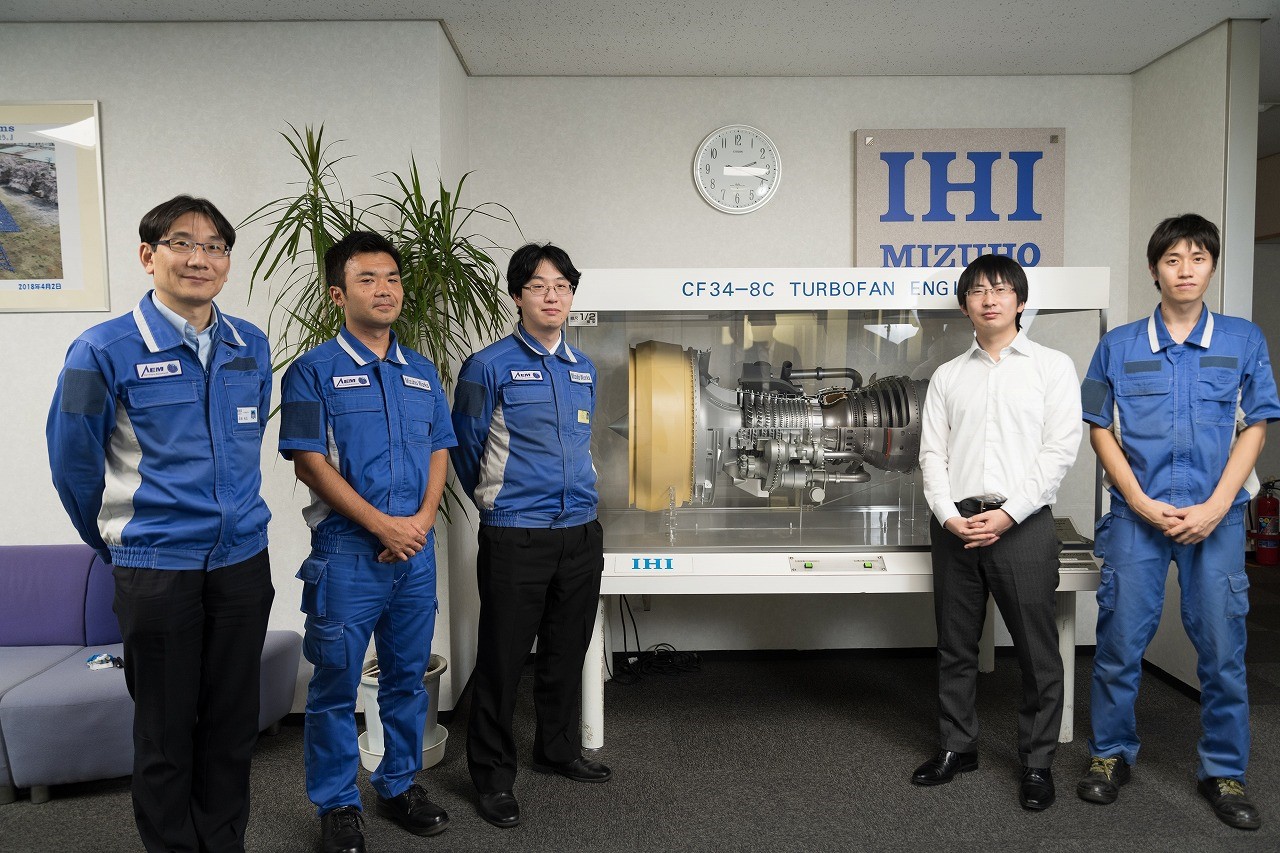
IHI Corporation
IHI traces its origins to Ishikawajima Shipyard, founded in 1853. In 1960 it merged with Harima Shipbuilding & Engineering to become Ishikawajima-Harima Heavy Industries, and in 2007 it changed its name to IHI to strengthen its global brand. Today, as a diversified heavy industry manufacturer, it delivers new value mainly in four business areas: resources and energy, social infrastructure, industrial machinery, and aerospace. Guided by its management philosophy, "Contribute to the development of society through technology," IHI applies its strong engineering capabilities to help solve many kinds of social issues.
Kazuhiro Ogiwara, Manager, ICT Group, No. 2 Quality Control Department, Mizuho Aero-Engine Works
Amane Nishi, ICT Group, No. 2 Quality Control Department, Mizuho Aero-Engine Works
Masaya Kurihara, Quality Engineering Group, No. 2 Quality Control Department, Mizuho Aero-Engine Works
Koji Nagura, ICT Group, No. 2 Quality Control Department, Mizuho Aero-Engine Works
Yuichi Nakamura, Parts Repair Group, Maintenance Department, Civil Aero-Engine Division
Background
Reducing the work of developing documents had been a challenge for years
IHI Corporation, one of Japan's leading diversified heavy industry manufacturers, does business around the world on the strength of its outstanding engineering capabilities, built on its manufacturing technology. It makes products in a wide range of fields, including aero engines, space, and defense; industrial systems and general-purpose machinery; resources, energy, and environment; and social infrastructure and offshore facilities.
IHI's Mizuho Aero-Engine Works was established in 1969 as a base for the company's aero engine, space, and defense business. It sits next to the U.S. military's Yokota Air Base. Besides assembling jet engines and space equipment, it maintains jet engines for commercial aircraft from Japan and other countries and for Japan Self-Defense Forces aircraft. The ICT Group in the No. 2 Quality Control Department is responsible for the information systems of this engine maintenance business. It built a business system called IEMS (IHI Engine Maintenance System) from scratch, and it also runs and manages the system.
"IEMS gathers data from many sources, such as the core systems of the production departments, along with data specific to the office departments, and stores it so that it can be put to use in daily work as business data. It is made up of many business subsystems, so naturally we often need to process data to produce all kinds of documents. Every time users in the business divisions need a new document or a change to an existing one, they send us a request to develop it. Building documents takes a lot of work, and reducing the person-hours involved had long been a challenge for us," says Kazuhiro Ogiwara, a manager in the group.

The people who use the documents also had usability problems. Amane Nishi of the ICT Group, No. 2 Quality Control Department, Mizuho Aero-Engine Works, explains:
"Users want to be able to click an output button once and get the document they need. But building the output function from scratch every time is inefficient. To keep up with so many individual document requests, we needed to cut development costs by making our document output tool more capable and by standardizing it."
A project was launched to solve these problems on both the development side and the user side, and Nishi took the lead in looking into a new way of producing documents.
Selection process
Looking for a way for users to work on documents directly
Nishi first considered building the document system entirely from scratch. But that would have added to the development work and also increased the work of operation and maintenance beyond what it already was. So Nishi soon gave up on that idea and began looking for a packaged document tool that could be built into IEMS as a service.
"IEMS uses a microservice architecture. It works by connecting services provided by small, independent subsystems. That's why our first requirement was a document tool with a REST API, so that document generation could be built in as a service in the same way. To reduce the load on the IT staff, we also required a tool that would let users design documents themselves and that could print documents," says Nishi.
The users, for their part, also wanted a way to create and edit documents directly. Yuichi Nakamura of the Parts Repair Group, Maintenance Department, Civil Aero-Engine Division, one of the user departments, explains why this was needed:
"Sometimes a document suddenly needs to be changed. We used to ask the IT staff to make the change every time, and each time, the IT staff and we users had to work out the details together. If we users could make minor changes to documents directly ourselves, we could deal with them first thing in the morning, and our work would move faster."

Masaya Kurihara of the Quality Engineering Group, No. 2 Quality Control Department, acts as a liaison between the user departments and the IT department. Adding to what Nakamura said, Kurihara explains why documents sometimes have to be changed in a hurry:
"Some business partners specify the format of documents such as quotations, so IHI isn't always in control of how its documents are made. Even when a format changes for the other party's reasons, we have to update ours right away. Being able to revise documents immediately on the user side, even in cases like these, was a big advantage."

Koji Nagura of the ICT Group, No. 2 Quality Control Department, Mizuho Aero-Engine Works, recalls how things were at the time: "Even for a very small change, such as a different font size on a document, users had to ask the IT department. It seems users felt awkward about asking us."
After gathering these requests, Nishi's team narrowed down the candidate document tools and compared them. One requirement they gave particular weight to was license cost.
"There are many document tools out there, and we looked at them from many angles. Some require a dedicated design tool to create and edit documents. At the Mizuho Works, dozens of users create and edit documents, so a tool they already know well was preferable. In particular, with a product that lets people create and edit documents in software they use every day, such as Excel, users can start working without any special training. We also had to take into account that if a dedicated design tool were required, license fees for every user would add up to a heavy burden," says Nishi.
That was when Docurain from Docurain Inc. caught their eye.
Results
Document development now takes about a third of the time
Interested in Docurain, Nishi's team asked Docurain Inc. for a detailed explanation. Docurain's main product is in fact its cloud version, which generates documents through a web API and is billed per API call. However, because of its internal IT infrastructure, IHI was not looking to run the system in the cloud. To meet IHI's needs, Docurain Inc. made a special on-premises version available, licensed per server, and first let IHI try out its features with a trial version.
Starting in February 2018, IHI spent about two months testing Docurain in detail. It confirmed that Docurain met requirements such as support for a REST API, the ability to use Excel as the design tool, and output in multiple file formats, including .pdf as well as .xlsx. Docurain also ran without problems in operational tests.
"Based on the results of testing the trial version, we decided to formally adopt Docurain. In the end, the deciding factors were that it had all the features our requirements called for and that it was very cost-effective. Compared with other document tools, it cost about one fifth as much because no design tool licenses were needed. It was the best choice for us," says Ogiwara.
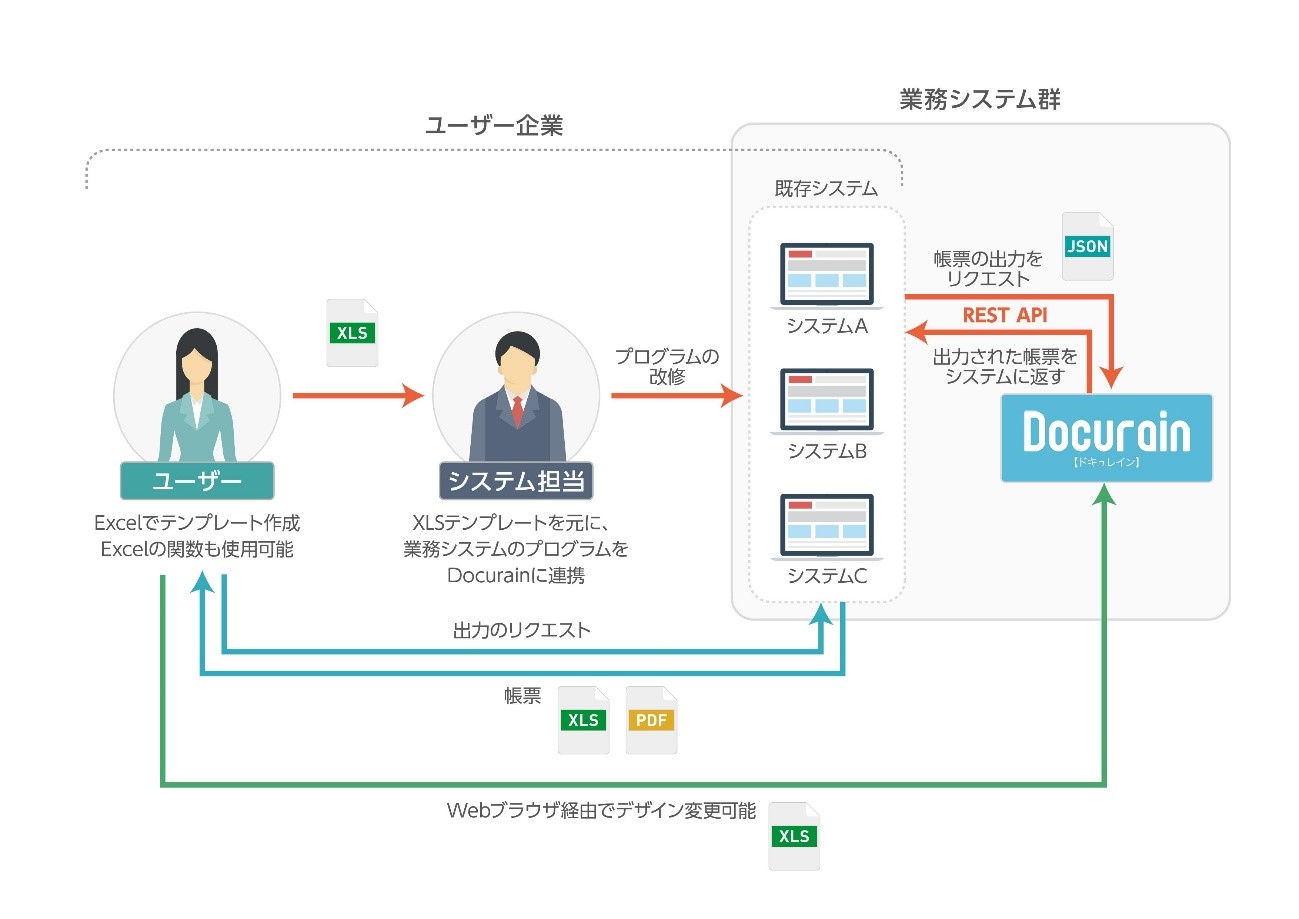
The diagram (in Japanese) shows users creating templates in Excel and the IT staff connecting the existing business systems to Docurain, which receives requests (JSON) through a REST API and returns the generated documents as XLS or PDF files. Users can also change template designs in Docurain through a web browser. Labels: ユーザー企業 = user company, ユーザー = user, システム担当 = IT staff, 業務システム群 = business systems, 既存システム = existing systems, 帳票 = documents.
IHI decided to adopt Docurain in March 2018. Working toward going live in June, the team prepared for the rollout. Among other things, it built a feature, based on the existing documents, that pulls data into a document with a single click of a button. With help from Nakamura, Kurihara, and others, the team also wrote and distributed its own user manual, setting things up so that everyone who works with documents could use the system easily.
After Docurain went live, the effect was dramatic. It drew a strong response from both the user departments and the IT department and brought both of them major benefits.
Nakamura, who works in a user department, says with a smile, "Now that users lead the creation and editing of documents, when a customer asks for a layout change, we can make the change in Excel and quickly apply it in Docurain. Before, we asked for the change, it was tested, and only then was it released. Compared with that, document development now takes between a half and a third of the time. For us in the user departments, who work close to customers, it's a very big improvement."
Kurihara, the liaison between the user departments and the IT department, stresses how much time has been saved: "Filling in a document used to mean copying data from the business system and pasting it in, which took about 30 minutes on average. Now it's done instantly. Even including checking, the time needed has dropped to about a third. And developing the output feature for that document, which would normally have taken several days, now takes a few hours."
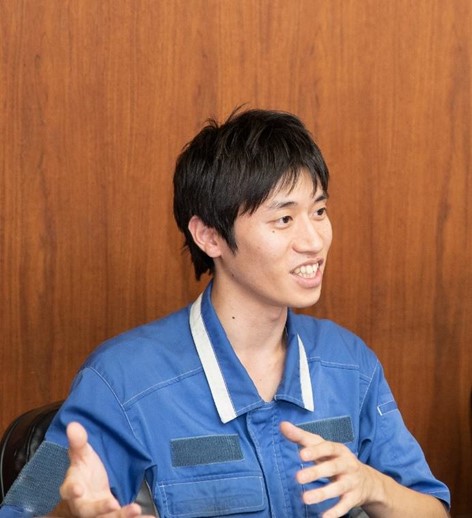
Ogiwara continues, "Until now, document development relied on the know-how of individual IT staff. Since adopting Docurain, we've been able to set proper rules for it." Besides the reduction in document development work, which was the original goal, he points to the value of greater standardization.
Adopting Docurain brought the user departments and the IT department major benefits in two areas: productivity and standardization.
Looking ahead
Hoping to use Docurain in more areas
IHI also rates Docurain Inc.'s support highly.
"Whenever we had a question or a problem, we reported it to Docurain Inc. and they dealt with it the same day. We also sent a few feature requests, and they were included in the next update. We value how flexibly they responded, adapting the tool to fit our company," says Nishi.

Finally, we asked Ogiwara to sum up the project.
"I think the real benefits of adopting Docurain are still to come. That said, we developers on the systems side see things differently from users. With many users involved in developing documents, users may start asking for ways of using Docurain that we developers never anticipated. I think insights like these will lead to further improvements in how we work. And I hope we'll use Docurain in more and more areas," says Ogiwara.
Back to case studies