Aioi Nissay Dowa Insurance Co., Ltd. has made improving operational efficiency by going paperless one of its key initiatives. As part of this effort, the company adopted Docurain for its various fire insurance documents and took those processes paperless. By eliminating paper documents while keeping document quality at the same level as before, it has made its operations much more efficient and cut costs significantly.
Aioi Nissay Dowa Insurance Co., Ltd.
A major non-life insurer takes its insurance documents paperless
and looks to develop its document templates in-house in the future

Aioi Nissay Dowa Insurance Co., Ltd.
Headquartered in Shibuya, Tokyo, Aioi Nissay Dowa Insurance is a non-life insurance company in the MS&AD Insurance Group that offers a wide range of insurance products to individual and corporate customers.
Formed in 2010 through the merger of Aioi Insurance Co., Ltd. and Nissay Dowa General Insurance Co., Ltd., it is one of Japan's leading non-life insurers. It offers a broad range of products and services, including auto, fire, and accident insurance.
Its business strategy is CSV×DX (Creating Shared Value by Digital Transformation). Under this strategy, the company uses data and digital technology to address unknown risks and social and regional issues, aiming to build a better future by advancing the value that insurance provides.
Fire Insurance Group, Business Administration Department, Aioi Nissay Dowa Insurance Co., Ltd.
Shinichi Nakade, Deputy Manager
Erika Sato
Satoko Kamiyama
Miwa Yamaji
Background
How to raise productivity and cut costs by taking operations paperless
Aioi Nissay Dowa Insurance has made "promoting paperless operations" one of its key initiatives. As part of this, it has made insurance policies and policy terms and conditions available online. Procedures such as taking out a policy or changing policy details used to require submitting paper documents. As one of the themes of the AD Smart agency system renewal project, the company is gradually rolling out ways to complete these procedures through its systems without paper.
"To make these paperless procedures possible, two things were essential. The first was a way to enter and register policy details online in place of the old paper application forms and pass them automatically to our host computer. The second was a way to output the policy details automatically as PDFs with the precision of commercial printing."
That is how Shinichi Nakade, Deputy Manager in the Fire Insurance Group of the company's Business Administration Department, describes it. The group manages the company's administrative systems for fire insurance. Since the paperless policy was announced across the company, the group has looked from many angles at how to move work that relied on paper documents smoothly into a paperless environment.
The group also frequently received requests from insurance agencies, which handle the hands-on work of writing new policies and updating existing ones, to improve the content and layout of application forms and other documents. Each time, the Fire Insurance Group sent a revision request to the printing company that produced its paper documents. According to Satoko Kamiyama, who handled this work in the group, the revisions took a considerable amount of time to complete.
"Every time we asked for a revision, we had to get a quote, and we even had to agree on how many rounds of proofing and corrections there would be during the revision. It took a great deal of time, effort, and money. Each additional round of proofing and corrections added more time and cost, and it wasn't unusual for even a very minor change to take several days."
Adoption
A paperless setup built on Docurain, which makes document development more efficient
While looking for a solution to these problems, Aioi Nissay Dowa Insurance learned about Docurain, a cloud-based document engine, from Docurain Inc. Docurain Inc. was already helping Aioi Nissay Dowa Insurance build business systems on another project. Because of that track record, the company also consulted Docurain Inc. about going paperless and received a proposal for a solution using Docurain.
Nakade recalls the impression the proposal made:
"In a typical waterfall development project, it's quite hard to change the specifications once they've been fixed during requirements definition. But Docurain Inc. uses an agile development process, and they told us they could incorporate our requests as development went along, so we thought we could develop the system flexibly."
With Docurain, you can build an advanced automated typesetting system through intuitive, Excel-based operations, so even ordinary users with no system development skills can easily set up automated typesetting. The company also thought that by making full use of this feature, it might eventually be able to create and update document templates in-house.
"Right now, we ask Docurain Inc. to create and update our document templates, but in the future we'd like to do that work in-house to speed it up and cut costs. Docurain was an extremely good fit for our needs in that respect, too." (Nakade)
In addition to the automated PDF typesetting with Docurain, Docurain Inc. also took on development of a document creation system that agency staff use to enter, online, the information printed on the documents. Miwa Yamaji of the Fire Insurance Group in Aioi Nissay Dowa Insurance's Business Administration Department worked on the screen design for this system. According to Yamaji, the plan from the start was for the company to handle updates to this system in-house as well.
"For the input system our agencies use, I wrote the screen specifications, and Docurain Inc. built the system from them using MOD99, its low-code platform technology. They also set things up so that, once the system was finished, I could make changes to the screens myself directly with MOD99. As a result,
when agencies ask us to improve the screens, we now handle almost all of the system changes in-house." (Yamaji)
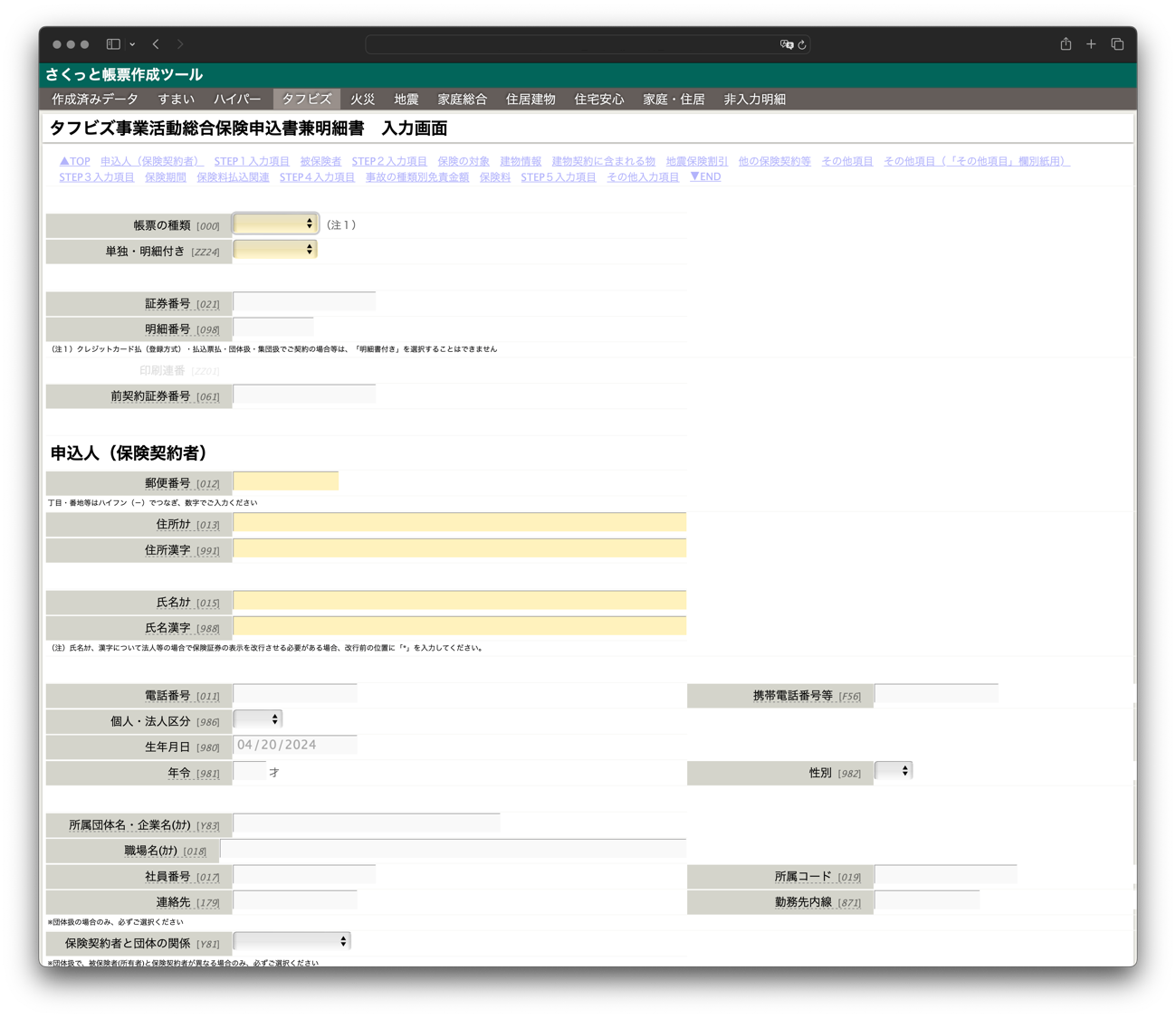
The screen is in Japanese. It is the input screen for a business insurance application, with fields for the policyholder's postal code, address, name, and phone number.

The screenshot shows the layout definition sheet of a screen design document, in Japanese. The sheet specifies input fields and their IDs, for example [証券番号] ID=021 (policy number) and [郵便番号] ID=012 (postal code).
Results
Document revisions that used to take several days can now be done in just 30 minutes
Development of these systems began in January 2023. As originally planned, it followed an agile approach and flexibly incorporated requests from Aioi Nissay Dowa Insurance as they came up. As a result, the system went live on schedule in October 2023.
The new agency system, built around Docurain, is now in use in day-to-day operations. According to Erika Sato of the Fire Insurance Group in the company's Business Administration Department, this has reduced the large volume of paper documents the company used to process.
"Because data now flows automatically to our core systems, we almost never need to print paper documents, and going paperless has progressed just as we hoped. Even so, the PDF documents Docurain Inc. made for us are every bit as good as the ones we used to have a printing company produce, so we've been able to keep quality high."
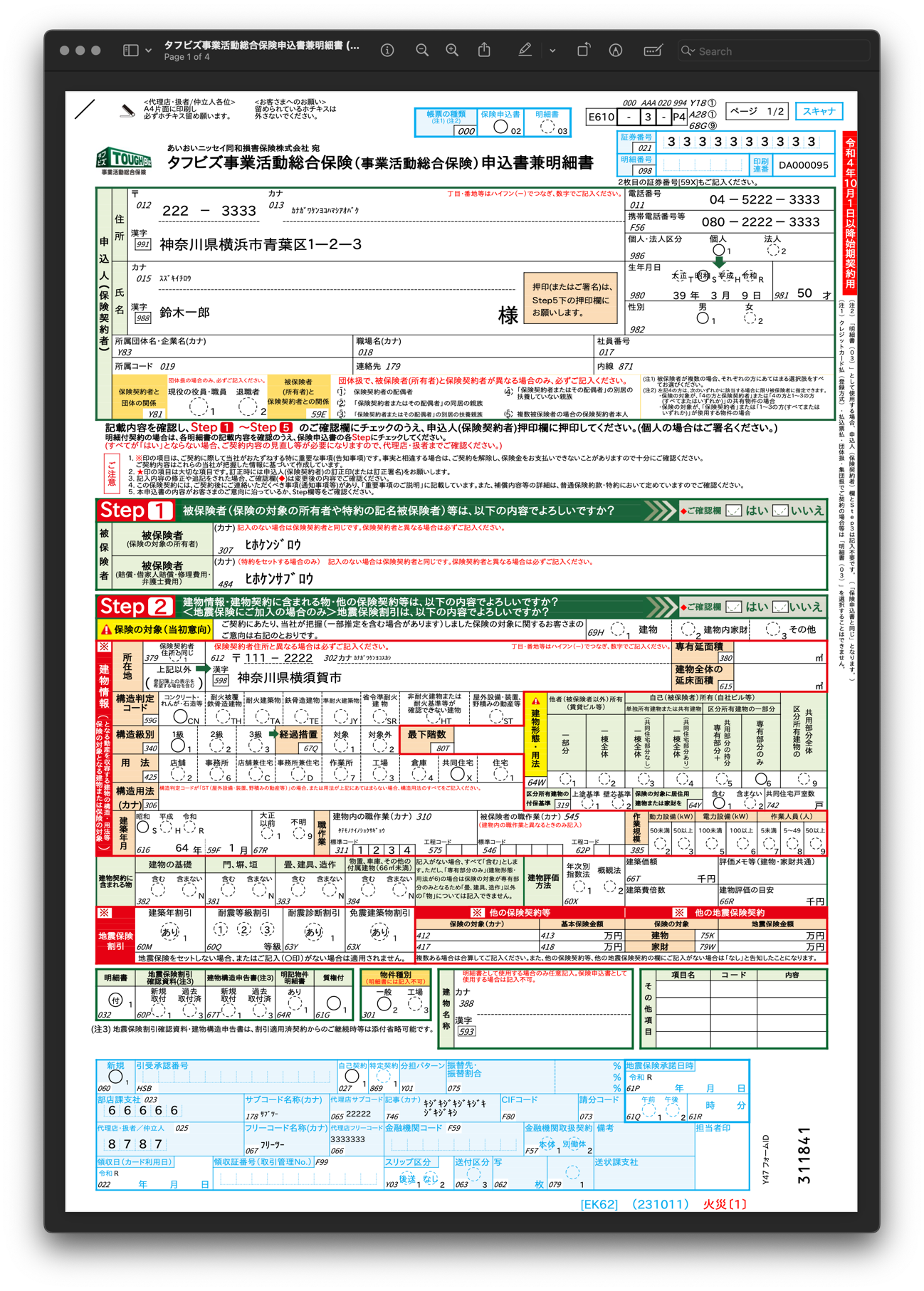
The document is in Japanese. It is an application form for business insurance.
Responding to agencies' requests to revise documents has also become much faster. Minor changes in just a few places used to take several days. Now, when the company asks Docurain Inc. for a revision, it can be done in as little as 30 minutes or so. As a result, the company can respond to agencies' needs flexibly and quickly, and it has also reduced revision costs.
Agencies sometimes ask the company to change the screen specifications of the input system. With Docurain Inc.'s low-code tool, the company can handle these requests quickly in-house, which has also greatly improved the quality of service it provides to agencies.
"Because you can change the screens easily, much as you would work in Excel, even staff with no system development experience quickly got comfortable using the low-code tool. The input system's UI also checks whether the information users enter is correct. That kind of complex validation would normally require programming, but we can implement it easily in the tool, which helps us a lot." (Yamaji)
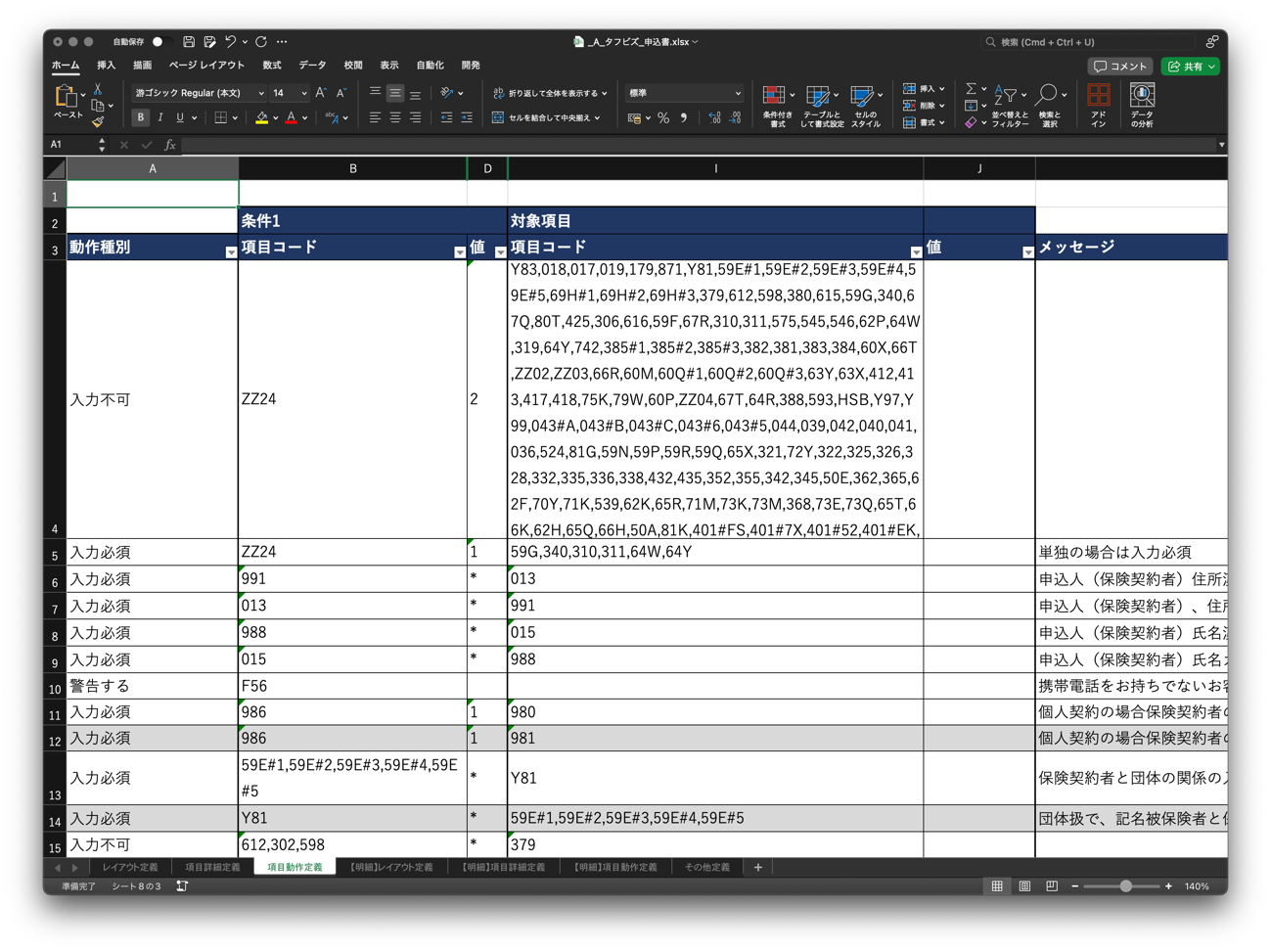
The screenshot shows the field behavior definition sheet, in Japanese. Each data row defines a rule for one or more fields. Labels: 動作種別 = action type, 条件1 = condition 1, 対象項目 = target fields, 項目コード = field code, 値 = value, メッセージ = message, 入力必須 = required, 入力不可 = not editable, 警告する = show a warning.
The company currently also relies on Docurain Inc. for system maintenance. Unlike with tools from overseas vendors, support comes directly from the Japanese vendor that actually developed the product, which makes quick and flexible responses possible.
"When we need support, we just send an email and they respond right away. They also suggest things beyond what we asked about, which is very reassuring." (Nakade)
Looking ahead
Extending Docurain to documents for other insurance products to increase the benefits
So far, the company has used Docurain to take about 20 kinds of its fire insurance documents paperless, and Nakade says it plans to expand that scope further.
"We want to build basically all new documents on the Docurain system from now on. Whenever an insurance product is revised, we have to create new documents for it anyway, so we'll migrate at those points, and eventually we plan to run all of our documents on the Docurain system."
Only fire insurance documents are covered for now, but Nakade hopes to extend this to other insurance products and to move documents for auto insurance, accident insurance, and other lines onto the system built in this project. By applying Docurain-based paperless processes to a wider range of documents, the company aims to spread the gains in efficiency and cost savings more widely, improve the quality of its customer service, and reduce its environmental impact by using less paper.
The company also aims eventually to bring in-house the work of creating new document templates and updating existing ones, which it currently asks Docurain Inc. to do. It plans to get there by making full use of one of Docurain's advantages: people can develop document templates easily without system development skills. The company hopes this will let it respond more quickly to agencies' requests to update documents and, in turn, improve the quality of service for policyholders.
Nakade says the company has high expectations for Docurain Inc.'s continued support in making these plans a reality.
"Our own team may change because of personnel transfers and so on. So we'd like Docurain Inc. to gain a deep understanding of our operations and strategy and to keep giving us strong, hands-on support based on a consistent approach, even if the people in charge on our side change. Beyond that, we also look forward to valuable proposals that help our operations and business grow."
Back to case studies